
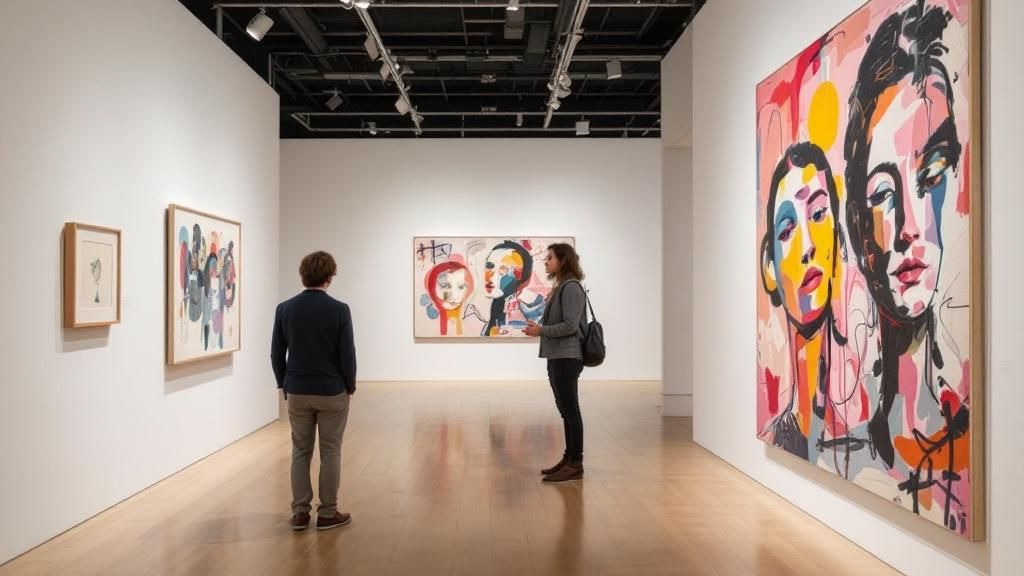
The Turner Prize has operated as a indicator of current creative innovation, and this year’s exhibition proves no exception. By showcasing works that intentionally obscure the lines dividing abstraction and representation, the curators have orchestrated a compelling interrogation to viewers’ preconceptions about what art can communicate. This article investigates how the featured practitioners employ non-traditional approaches and theoretical structures to challenge our comprehension of artistic vocabulary, ultimately considering whether the conventional separations between abstract and representational art remain meaningful in today’s creative landscape.
Reconsidering Theoretical Frameworks
The Turner Prize display this year deliberately dismantles conventional categorisations that have historically shaped artistic discourse. By presenting works that seamlessly oscillate between abstraction and figuration, the curators prompt viewers to question their beliefs about how we create visual meaning. The exhibition demonstrates that modern artists increasingly move away from binary categories, instead pursuing hybrid strategies that interrogate how we perceive and interpret visual information. This curatorial method prompts visitors to engage more critically with the artist’s intention and aesthetic experience.
These boundary-crossing works demonstrate a broader shift within current art practice towards fluid conceptualization and experiential ambiguity. Rather than adhering to rigid stylistic categories, the presented artists utilise techniques that deliberately destabilise audience expectations. The display demonstrates that abstract and representational work are not entirely separate territories but rather positions on a unified continuum. This reconceptualisation encourages deeper contemplation about how meaning emerges through the interaction between artwork, viewer perception, and contextual interpretation, profoundly altering critical dialogue.
The Development of Visual Language
Visual language has witnessed substantial evolution across the twentieth and twenty-first centuries, particularly as artists engaged with photography’s threat to representational painting. Modernist movements initially framed abstraction as a revolutionary departure from mimetic traditions, creating apparently unbridgeable conceptual divides. However, modern artists are coming to see these earlier divisions as constructed boundaries. The exhibition illustrates how visual language develops naturally, integrating varied sources and methodologies that move past traditional categorical boundaries, mirroring our growing sophisticated visual culture.
Contemporary artists now synthesise elements from abstraction, representation, and theoretical structures with remarkable complexity. This combined methodology acknowledges that artistic expression operates through multiple interpretive pathways simultaneously. The Turner Prize exhibition showcases how artists employ colour, form, composition, and symbolic reference to create complex significations that defy singular interpretation. This evolution demonstrates that creative vocabulary has matured beyond dogmatic constraints, favouring instead a sophisticated lexicon capable of expressing the intricacies inherent in modern life and perception.
Present-Day Interpretations
Modern artists explore abstraction with markedly distinct theoretical foundations than their past practitioners, drawing from postmodern theory, digital culture, and international creative traditions. Rather than seeking pure abstraction as an conceptual destination, contemporary practitioners treat abstract elements as vehicles for communication within wider strategic frameworks. The display features works wherein geometric structures, mark-making, and colour interactions sit alongside figurative imagery and textual elements. This multi-faceted approach reflects current perspectives that visual significance develops through multifaceted exchanges rather than through singular stylistic commitments or stylistic dogmas.
The selected artists display remarkable facility in navigating multiple visual registers simultaneously, producing works that reward careful consideration and interpretive flexibility. Their work suggests that modern artistic practice increasingly functions as a conversation among artist, artwork, and viewer, rather than as a one-way pronouncement. By integrating diverse visual languages, these artists acknowledge that the creation of meaning in modern cultural contexts requires sophisticated navigation of conflicting visual frameworks. The exhibition ultimately proposes that modern critical understanding demands viewers relinquish fixed categorical approaches, embracing instead the generative uncertainty that characterises sophisticated artistic practice.
Critical Reception and Public Discourse
The exhibition has prompted substantial debate amongst academic and critical circles, with responses ranging from strong approval to cautious doubt. Classical advocates have queried whether the merging of abstract and figurative distinctions constitutes genuine innovation or just artistic uncertainty. In contrast, contemporary perspectives have applauded the curators for questioning ossified categorisations that no more reflect contemporary artistic practice. This range of viewpoints demonstrates the exhibition’s significance as a driver of substantive conversation within artistic circles and wider society.
Public participation in the exhibition has exceeded expectations, drawing varied visitor groups beyond the established art-world circles. Social media discussion shows that visitors are actively grappling with the pieces’ underlying concepts, exchanging viewpoints and questioning different viewpoints. Museums have documented greater attendance and extended viewing times, suggesting that audiences are truly committed to understanding creative intent. This grassroots enthusiasm shows that present-day creative work can resonate powerfully with the broader community when given appropriate interpretive guidance and cognitive accessibility.
The exhibition’s influence reaches beyond direct critical evaluation, possibly shaping future how curators work and creative direction within institutional structures. Emerging artists have pointed to the exhibition as a pivotal moment, affirming experimental approaches that synthesise the abstract and the representational. Learning institutions are beginning including the exhibition’s ideas in their teaching programmes, acknowledging its educational value. As discussions continue forward, the Turner Prize exhibition seems poised to hold a prominent role within contemporary art history, reshaping discussions concerning artistic categorisation and creative potential.
